What If a Movie No Longer
Needed to Cost Millions?
A feature film is a project management problem wearing an art form's clothes. Attack coordination rather than generation and the arithmetic changes fast.
By Serverless Ventures, Media
Published: September 8, 2026 · Read time: ~13 minutes
The film industry has spent two years arguing about whether AI can generate convincing video. That argument is loud, unresolved, and beside the point.
A feature film is a project management problem wearing an art form's clothes. It costs what it costs because of scheduling, day rates, location logistics, insurance and the overhead of coordinating two hundred people across forty days. Very little of that is the camera.
The argument in one paragraph
Attack coordination rather than generation and the arithmetic changes fast. This piece works the numbers line by line against one real film, arrives at a defensible reduction near ninety percent, then argues the cost collapse is not the disruption. The disruption is what happens when an industry's primary risk control stops working.
Start with a 21-year-old producer

In August 2026, a film called Hanuman Ansh opened in Indian theatres and took roughly ten lakh rupees on its first day. About eleven thousand dollars. By any studio metric, a non-event.
Twenty seven days later its net collection stood at ₹61.38 crore, with a gross of ₹72.32 crore. Around 8.2 million dollars.
Production budget, about $227,000
Gross at day 27, about $8.2M
Gross return on negative cost
That return came from a debut producer named Anupriya Nagar, a 21-year-old economics student at the University of Bath who came to the project by an unusually indirect route. She had been researching how technology founders formed their ideas, found the connection between Steve Jobs and the spiritual figure Neem Karoli Baba, abandoned a planned move to Switzerland, returned to India, and met the director Vishal Chaturvedi, who was already making a film about him.
There is no AI in this story. That is exactly why it is the right place to begin.
Hanuman Ansh is proof that the relationship between budget and outcome has already broken. A film costing 2.3% of a conventional ten million dollar feature outgrossed what most of those features earn, with no stars, no franchise and no marketing budget worth the name.
But it proves a narrower point than it first appears. Hanuman Ansh is a contained devotional drama. No creatures, no crowd battles, no destroyed cities, no period reconstruction. It is cheap partly because it never needed spectacle.
The real question was never whether films can be made cheaply. The question is whether films that need spectacle can be made cheaply, because that is the category where the ten million dollar floor has been genuinely load-bearing. That is the question AI actually answers.
Where the $10 million actually goes
Before claiming a reduction, you need an honest baseline. Here is a representative ten million dollar feature, broken down the way a line producer would build it.
| Line item | Cost | Share |
|---|---|---|
| Story, script and rights | $0.30M | 3% |
| Producers | $0.50M | 5% |
| Director | $0.50M | 5% |
| Cast | $1.50M | 15% |
| Production unit: crew, equipment, locations, art, wardrobe, transport | $3.70M | 37% |
| VFX | $1.30M | 13% |
| Post: edit, sound, colour, score | $0.80M | 8% |
| Insurance, legal, contingency, overhead | $1.40M | 14% |
| Total | $10.00M |
Two things here matter more than the rest.
The production unit at 37% is not one cost, it is a product: daily burn multiplied by shooting days. A film like this shoots roughly 42 days at around 88,000 dollars a day. Remove a shooting day and you remove 88,000 dollars. Shrink the unit and you lower the multiplier on every remaining day.
Contingency at 14% is a function of uncertainty, not ambition. You carry it because you do not know whether the location floods, the actor falls ill, or the vendor misses. Reduce the uncertainty and the line shrinks on its own.
Notice what is small. Script is 3%. The thing the film is actually about costs less than the insurance.
Now run the same analysis on ₹2 crore
The theoretical model above deserves an empirical control. No line-item budget for Hanuman Ansh is public, so what follows is a reconstruction at industry-typical proportions for a film of that scale and genre. Treat it as an estimate, not a disclosure.
| Line item | ₹ lakh | USD | Share | $10M film |
|---|---|---|---|---|
| Story, script and rights | 8 | $9,091 | 4.0% | 3.0% |
| Producers | 12 | $13,636 | 6.0% | 5.0% |
| Director | 15 | $17,045 | 7.5% | 5.0% |
| Cast | 30 | $34,091 | 15.0% | 15.0% |
| Production unit | 75 | $85,227 | 37.5% | 37.0% |
| VFX | 15 | $17,045 | 7.5% | 13.0% |
| Post: edit, sound, devotional score, colour | 25 | $28,409 | 12.5% | 8.0% |
| Insurance, legal, contingency | 20 | $22,727 | 10.0% | 14.0% |
| Total | 200 | $227,273 |
Look at the right two columns. The shape is nearly identical. Production unit at 37.5% against 37.0%. Cast at 15.0% against 15.0%. VFX is lower and post is higher, which is exactly what you would expect from a devotional drama with a score that carries the film and no creatures to build.
This is the finding that matters, and it cuts against the easy reading of the story. Hanuman Ansh did not restructure film production. It ran the same production model at Indian input prices, without stars and without spectacle. The budget shape of a feature film is close to scale-invariant, which tells you the model has not changed in decades. Only the price level moves.
The daily arithmetic makes the gap concrete. Roughly 38 shooting days against ₹75 lakh of production unit is about ₹1.97 lakh a day, or $2,243. The ten million dollar feature burns $88,000. That is a 39× difference in the price of a shooting day, and none of it is technology.
Now the return. Opening day was ₹10 lakh, five percent of the negative cost. Day 27 net was 614 times opening day. No paid media campaign produces that curve. That is a specific audience finding a film about a subject it already cared about.
That curve ran in public, on the same platforms that carried the word of mouth:
The run did not stop at day 27. By early September the film was reported to have crossed ₹150 crore. Every figure in this piece uses the day 27 numbers, because that is the window the budget arithmetic below is anchored to, and because a 36× return is already past the point where the argument needs a bigger multiple.
The uncomfortable test
Push Hanuman Ansh itself through the tier four pipeline described later in this piece and the budget falls from ₹200 lakh to roughly ₹70 lakh, including an inference bill of about ₹6 lakh. A 65% reduction, not 88%.
AI cannot cut what was never spent. Compression assumes there is fat to compress, and this film had already banked most of the available savings by casting unknowns and staying inside real locations. Every headline reduction figure, including the one in this article, is a claim about how much waste the baseline contained.
Which reframes the whole opportunity. That same ₹2 crore, spent through an AI-native pipeline, buys either about three films at this scale or one film with ten million dollars of visual ambition. A contained devotional drama at this budget already grossed ₹72 crore on word of mouth. Nobody yet knows what the same budget does with creatures, crowds and period cities in it.
AI does not make movies cheaper. It changes the production model
Here is where most industry analysis goes wrong, and where the honest numbers get uncomfortable.
Drop generative tools into a conventional production and you save very little. Call this tier one. The concept artist works faster, the VFX vendor automates rotoscoping, the editor gets assisted assembly. The schedule does not change. The crew does not shrink. The cast is unchanged.
That explains the disappointment circulating in studios that ran AI pilots. They bought tools and kept the workflow, so they bought a discount on a fifth of the problem.
Tier two changes the workflow. Previsualisation becomes decision-grade rather than illustrative, which means blocking, lensing and coverage are settled before anyone stands on a set. Virtual production replaces location travel. The shoot compresses from 42 days to 14. VFX moves from a vendor pipeline to an in-house generative one.
And here the structure of the problem becomes visible. In tier two, cast is 39% of the entire budget. The star salary did not move, so as everything else fell, talent became the dominant line item. AI does not compress human negotiating leverage.
Tier three drops star casting. Unknown or emerging actors, cast on suitability rather than opening-weekend insurance.
That is as far as technology alone gets you. The remaining eight points require something else.
The movie studio becomes a software system
To understand where the last of the cost goes, you have to look at what an AI-native production actually is architecturally. It is not a set of tools. It is a pipeline with persistent state.
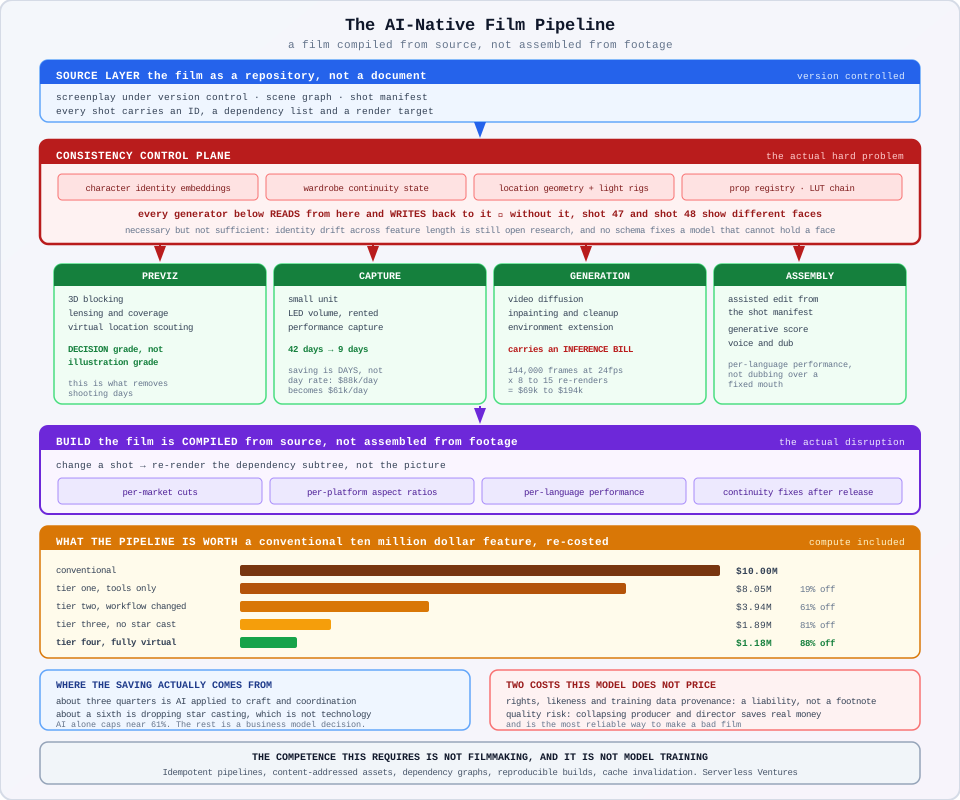
The component that matters is the consistency control plane. Every generator reads from it and writes back to it, which is why this is a state management problem rather than a model quality problem.
This is the part the public conversation misses. Generating one striking shot is solved. Generating shot 47 and shot 48 with the same actor, the same jacket, the same scar on the same cheek, under the same key light, at the same focal length, is not a generation problem. It is a database problem with a rendering front end.
State management is necessary here but not sufficient. Identity drift across a feature-length sequence is still an open research problem, and no amount of schema design fixes a model that cannot hold a face. What the control plane does is remove the failure mode you can engineer away, leaving only the one you cannot.
Which means the competence required to build an AI-native studio is not filmmaking competence and not model training competence. It is largely distributed systems competence. Idempotent pipelines, content-addressed assets, dependency graphs, reproducible builds, cache invalidation. The people who can build this already work in infrastructure.
That architecture is also what produces the final cost reduction. Once the film is a build artifact, the producer and director roles compress, because the coordination work those roles historically absorbed has been encoded into the pipeline. Half a producer's job is knowing what state the production is in. If the repository knows, the job shrinks.
The 90% cost question
Tier four collapses the creative leadership into a single accountable role and moves environments fully virtual, eliminating the location unit entirely.
| Line item | Baseline | Tier one | Tier two | Tier three | Tier four | Cut |
|---|---|---|---|---|---|---|
| Story, script, rights | $0.30M | $0.18M | $0.08M | $0.06M | $0.05M | 83% |
| Producers | $0.50M | $0.50M | $0.30M | $0.22M | $0.14M | 72% |
| Director | $0.50M | $0.50M | $0.40M | $0.30M | $0.22M | 56% |
| Cast | $1.50M | $1.50M | $1.50M | $0.14M | $0.11M | 93% |
| Production unit | $3.70M | $3.00M | $0.90M | $0.55M | $0.24M | 94% |
| VFX | $1.30M | $0.65M | $0.16M | $0.13M | $0.09M | 93% |
| Post | $0.80M | $0.45M | $0.14M | $0.11M | $0.08M | 90% |
| Insurance, contingency | $1.40M | $1.25M | $0.38M | $0.28M | $0.13M | 91% |
| Compute and inference | $0.00M | $0.02M | $0.08M | $0.10M | $0.12M | new cost |
| Total | $10.00M | $8.05M | $3.94M | $1.89M | $1.18M | 88.2% |
Note the line that did not exist before. An AI-native production has an inference bill, and most published models of this quietly omit it. A hundred minute feature is 144,000 delivered frames, and you do not render each one once. At eight re-render passes and six cents a frame it is about $69,000. At fifteen passes and nine cents, closer to $194,000. Budget $120,000 and you are being realistic rather than optimistic.
With that line included the reduction is 88.2%, not 89.4%. Ninety percent is reachable at the efficient end of that compute range, and it is honest to say the model sits between 88 and 90 rather than to quote the round number.
Of the total $8.82M saving, roughly three quarters comes from AI applied to craft and coordination. About seventeen percent comes from the casting decision, which is not a technology choice at all. The final push from tier three to tier four is 42% production unit and 20% contingency, with the rest from collapsing the creative team.
The shoot-day model is the clearest single view of it:
| Configuration | Shoot days | Daily burn | Production cost |
|---|---|---|---|
| Conventional | 42 | $88,000 | $3,696,000 |
| AI-restructured | 14 | $64,000 | $896,000 |
| AI-native | 9 | $61,000 | $549,000 |
| Fully virtual | 4 | $60,000 | $240,000 |
The saving is overwhelmingly in days, not in day rate. A crew on an AI-native production still costs real money per day. There are simply far fewer days, because decisions that used to be made on set through expensive iteration are now made in previz through cheap iteration.
Two honest caveats. This model assumes a spectacle-carrying film, where VFX and location costs are large enough to compress. A dialogue-driven chamber drama has less to give, because its budget is already mostly people. And tier four's 93% cast reduction is a business model change with real consequences, discussed below.
When making movies becomes cheap, attention becomes expensive
Now the part that should worry anyone planning to exploit this.
Cost was never only a cost. It was a filter. A ten million dollar budget meant a small number of films got made each year, which meant distribution could physically evaluate all of them, which meant a good film had a plausible route to being noticed.
Films a $10M fund can finance
Theatrical breakeven per film
Probability of at least one hit per slate, at a 15% hit rate
That is a spectacular improvement for a portfolio investor and a catastrophic one for an individual film, because everyone else's fund did the same arithmetic. Supply expands by an order of magnitude. Demand, measured in human hours available to watch things, does not move at all.
So the binding constraint migrates. It leaves production and lands on discovery, and discovery does not obey the same cost curve. You cannot generate attention with a diffusion model.
The 614× curve in the section above is the relevant precedent. That film did not solve distribution with money. It solved it by being about something a specific audience was already looking for. In a world of nine films per fund instead of one, that is the only mechanism that scales.
The new film industry
What this implies structurally:
Studios become capital allocators, not production organisations
If production costs a tenth of what it did, owning production capacity is not a moat. Owning a library and a distribution relationship still is.
The talent premium concentrates rather than disappears
Tier two showed cast reaching 39% of budget as everything else fell. Stars become more valuable in relative terms, because they are the one input that has not deflated. The middle of the market absorbs the compression.
Production infrastructure becomes a software category
The consistency control plane described above is a product, and whoever ships the reliable version of it occupies the position Avid and Adobe occupy today. That is an infrastructure company, not a media company.
Two costs this model does not price
Rights and likeness are the first. Synthetic or augmented performance sits on training data provenance and on actor consent agreements that are still being litigated and negotiated territory by territory. That is a legal line item and a liability, not a footnote, and it can move a budget more than any efficiency above.
The second is quality risk. Collapsing producer and director into one accountable role saves real money and is also the most reliable way to make a bad film. Every studio structure that looks like bureaucracy is partly a check on a single person's judgement, and removing it is a bet on that person.
Regional cinema is the immediate beneficiary
The economics work first where budgets were already low and audiences are already specific. India, Nigeria, Indonesia, the Gulf. A 90% reduction on a $10M film is interesting. A 90% reduction on a ₹2 crore film makes an entire category of story economically viable for the first time.
The real disruption is not AI-generated video
Everything above is downstream of one architectural change, and it is not generation.
It is that a film stops being an artifact and becomes a build.
A conventional film is a fixed output. Once it is locked, changing it means reopening post at significant cost, which is why films ship once and stay shipped. Every business practice in the industry, release windows, territorial licensing, remastering as a separate commercial event, follows from the expense of change.
An AI-native film is compiled from a source repository with a dependency graph. Change a line of dialogue and you re-render the affected shots, not the picture. Which makes a set of things cheap that have never been cheap before. Per-market cuts. Per-platform aspect ratios. Genuine per-language performance, not dubbing over a fixed mouth. Continuity fixes years after release. A director's cut that costs a build, not a reshoot.
The industry is preparing for a fight over whether synthetic actors are acceptable. That fight is real and it is a surface argument. The deeper change is that films become software, and software has different economics, failure modes, labour structures and lifespans than manufactured goods.
Ninety percent cheaper is the headline. Version-controlled and recompilable is the event.
And the useful thing about Hanuman Ansh is that it proves the demand side before the technology arrives to serve it. A 21-year-old with no industry position found a story a specific audience wanted and returned 36 times her budget, using conventional filmmaking and an unconventional read on what people were looking for.
The technology now makes her configuration available to films that need dragons.
A note on the numbers
The $10M baseline is a representative line-producer breakdown, not a specific film. The Hanuman Ansh line items are a reconstruction at industry-typical proportions, not a disclosed budget; only the total, the box office figures and the production details are reported. Tier costs and the inference estimate are modelled, and the compute range is wide enough that the headline reduction should be read as 88 to 90 percent rather than a single number.
About this piece
Serverless Ventures builds AI infrastructure and advises on the systems architecture behind AI-native products. If you are building in this space, we should talk.
Published as media commentary. Not investment advice. Cost figures are modelled estimates; box office and production figures are as reported in September 2026.